Courses / European space observatories Space programs and missions · A guided course
European space observatories Different measurements, complementary views of the Universe
Explore eight European and internationally partnered observatories through stellar positions, changing light, high-energy photons, cool dust and cosmological surveys.
Start learning Suggested preparation is listed in the course · Start whenever you’re ready
Read learner reviews ↓
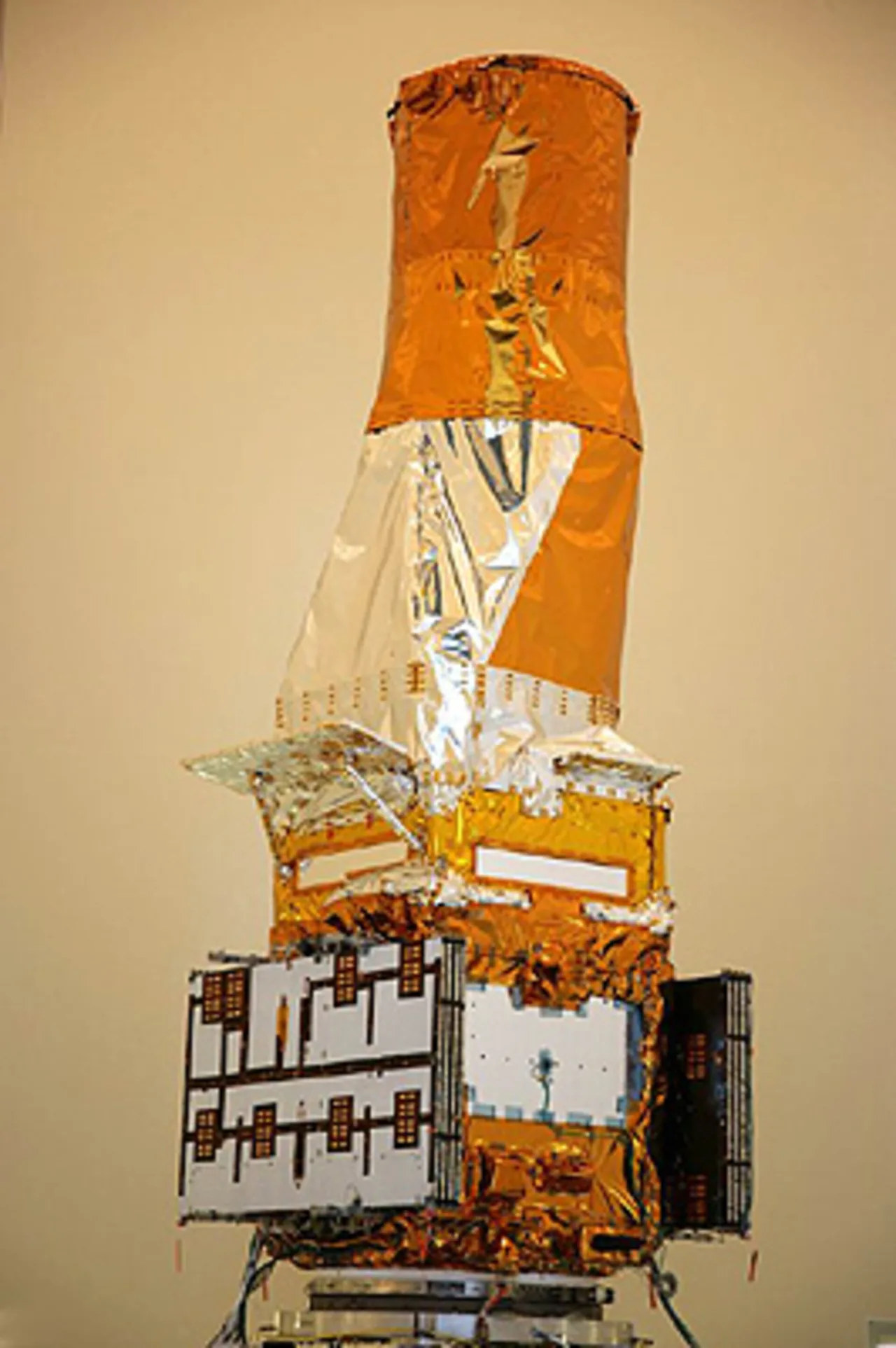
Alcatel Alenia Space / J. L. Bazile · Image source Your place in the bigger picture
How this course connects Build on familiar ideas, then choose a direction to explore next. Every course remains open.
Explore other learning paths → 02 You are here European space observatories
Different measurements, complementary views of the Universe
8 lessons · 64 min Loading progress…
Start whenever you’re ready. Preparation is suggested, and every course stays open.
03 Next directionsChoose another direction No follow-on course currently lists this one as preparation. Explore another subject or revisit an idea that caught your interest.
Browse all courses → Trace the full preparation path 23 courses One suggested order from the foundations to European space observatories. Shared starting points appear once; skip anything you already know.
Loading progress… Loading progress… Loading progress… Loading progress… Loading progress… Loading progress… Loading progress… Loading progress… Loading progress… Loading progress… Loading progress… Loading progress… Loading progress… Loading progress… Loading progress… Loading progress… Loading progress… Loading progress… Loading progress… Loading progress… Loading progress… Loading progress… Loading progress… Then: European space observatories →
Correct answer +10
Lesson complete +25
All lessons complete +100
Final challenge +50 Earn each reward once. Retries never cost points.
Loading saved points… View your learning awards →
Inside this course 8 lessons Each lesson builds on the last. Read the story, explore the sources, and check your understanding.
0 of 8 lessons complete
— / 640 points Earned in this course
01 Hipparcos Hipparcos: measure a moving sky Explain how repeated angular observations support stellar positions, motions and distances, and how the mission recovered from an orbital setback. 8 min · Read · Practice 02 Gaia Gaia: build a three-dimensional stellar census Distinguish positions, parallax, motion and spectral information, and read a star-density map without confusing it with a complete three-dimensional census. 8 min · Read · Practice 03 Corot CoRoT: read planets and stars in changing brightness Explain how one photometric mission investigated both transiting planets and stellar interiors while preserving alternative explanations for brightness changes. 8 min · Read · Practice 04 Xmm-newton XMM-Newton: use X-rays to examine hot and extreme matter Connect grazing-incidence optics, spectra and time variability with investigations of energetic astronomical sources. 8 min · Read · Practice 05 Integral INTEGRAL: reconstruct the high-energy sky Explain coded-aperture imaging and the value of coordinated observations for short-lived high-energy events. 8 min · Read · Practice 06 Herschel Herschel: examine the cool and dusty Universe Connect far-infrared observations, detector cooling and spectral measurements with studies of stars, gas and dust. 8 min · Read · Practice 07 Planck Planck: separate an early-Universe signal from the foreground sky Explain how multi-frequency observations and statistical models connect microwave maps with cosmological inferences. 8 min · Read · Practice 08 Euclid Euclid: test cosmic structure with galaxy shapes and distances Connect weak lensing and galaxy clustering with indirect tests of dark matter, dark energy and gravity. 8 min · Read · Practice Put it all together European space observatories challenge 5 questions · 8 min · Final review Where this course fits → No account is needed to learn. Your correct answers keep their earned rewards.
What you’ll understand Match each observatory to its measurements and scientific questions. Separate spacecraft milestones, observation products and inferred results. Read uncertainty, calibration, sampling and selection effects before comparing data. Explain how complementary observations test physical models. Take one lesson at a time. Study the evidence, work through a question, and check your understanding along the way. A final challenge connects ideas across all 8 lessons. Follow the source links whenever you want to go further.
Browse the archive → Loading reviews…
Sign in to review this course . Complete a lesson check and save it to your account first.
Show reviews in All languages English Español / Spanish Français / French Deutsch / German Português / Portuguese 中文 / Chinese 日本語 / Japanese 한국어 / Korean Русский / Russian العربية / Arabic हिन्दी / Hindi Other / not specified Languages are chosen by reviewers. Ratings above include all languages.