OAST-1 Solar Array
Deployable solar-array experiment
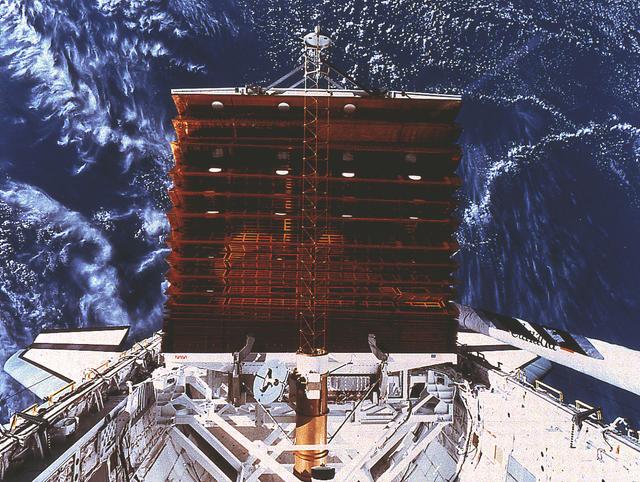
OAST-1 was a full-scale deployable solar-array technology experiment carried in Discovery's payload bay on STS-41-D. Lockheed built the lightweight blanket and coilable longeron mast for NASA Marshall to demonstrate compact stowage, controlled deployment, structural dynamics, and photovoltaic packaging at a scale relevant to future high-power spacecraft. The array was repeatedly extended and retracted in orbit, including a partial dynamics configuration and its complete 31.5-meter deployment.
Parent systems
The larger spacecraft or system this hardware belongs to.
Payload dossier
Identity and integration
- Official experiment designation
- Office of Aeronautics and Space Technology-1 Solar Array Flight Experiment (OAST-1)
- Manufacturer and program integration
- Lockheed Missiles and Space Company developed the flight array under NASA Marshall Space Flight Center management
- Program function and legacy
- The experiment supplied flight data for large, low-mass solar arrays intended to power future orbital platforms rather than serving as Discovery's operational electrical source
Structure and integration
- Structural construction
- An accordion-folded, 3-mil Kapton solar blanket supported by two coilable longeron masts and lightweight transverse battens
- Blanket-panel construction
- Eighty-four panels, each approximately 15 inches in the deployment direction and 13 feet across, formed the flexible blanket
- Deployed dimensions and span
- Approximately 31.5 meters (102 to 105 feet) long and 4 meters (13 feet) wide when fully extended
Power and thermal capability
- Photovoltaic power potential
- A fully populated flight-size array was calculated to provide about 12.5 kilowatts; the experiment carried only two active solar-cell panels because its primary objectives were structural and deployment testing
Dimensions and mass
- Stowed dimensions
- The accordion-folded blanket occupied a stack only about 17.8 centimeters (7 inches) deep before mast deployment
- Specific-mass performance
- The flight concept targeted roughly a threefold improvement in array specific mass over conventional rigid-panel technology
Assembly and operations
- Deployment mechanism and operation
- Motor-driven coilable longeron masts pulled the folded blanket outward from its payload-bay canister while transverse members maintained array width
- Structural-dynamics test operation
- The crew first deployed the array to approximately 70 percent length for dynamics measurements, then completed full extensions and retractions
- Carrier-mission operation
- Discovery retained the complete experiment in its payload bay throughout STS-41-D and returned it to Earth after the deployment series
Additional specifications
- Stowed-volume performance
- The foldable blanket and coilable masts demonstrated about a tenfold improvement in specific stowed volume
Supported mission records
Missions that carried, used, tested, serviced, or depended on this hardware.
Photo Archive
Documented views of this individual vehicle, with source and credit retained alongside each image.