PayloadMission concluded
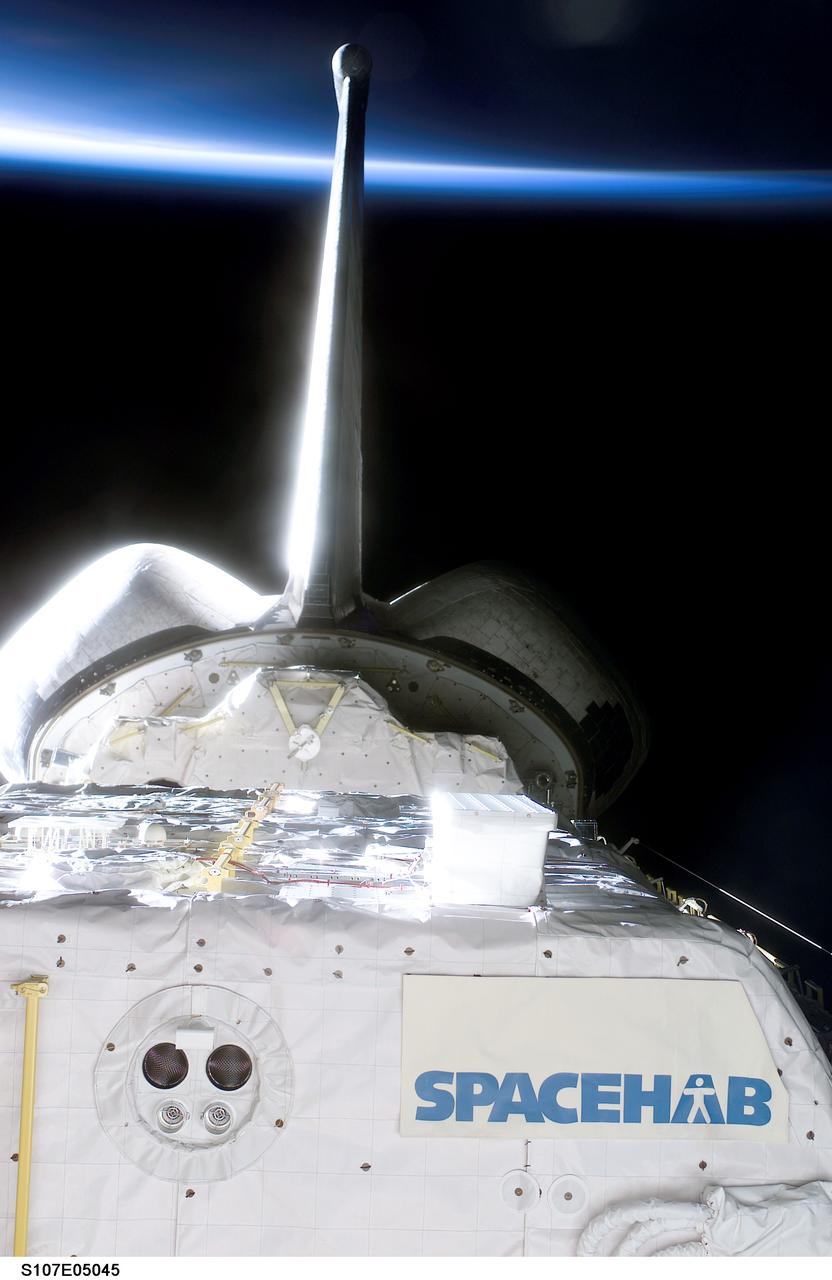
SPACEHAB Double Research Module
Pressurized orbital research laboratory
The SPACEHAB Research Double Module was the pressurized laboratory at the center of STS-107. Two connected aluminum segments provided a larger crew-accessible rack, locker, and work envelope for 32 payloads encompassing 59 investigations. Columbia's crew worked in shifts to operate life-science, physical-science, commercial, international, and station-risk-reduction research using the module's electrical, command-and-data, ventilation, and liquid- or air-cooling services.
Parent systems
The larger spacecraft or system this hardware belongs to.
Payload dossier
Identity and integration
- Official configuration designation
- Research Double Module
Research configuration
- Module dimensions
- Approximately 20 feet long, 14 feet wide, and 11.2 feet high for the two-segment pressurized assembly
- Experiment and cargo accommodation
- Two connected module segments accepted standardized lockers, single and double experiment racks, stowage structures, and mission-specific cargo restraints
- Research or logistics complement
- 32 crew-tended payloads comprising 59 investigations in life, physical, commercial, station-risk-reduction, and international research
Resources and accommodations
- Pressurized volume
- Two joined module segments roughly doubled the single module's pressurized work and stowage envelope
- Payload mass capacity
- Two connected aluminum pressure modules expanded the crew-accessible rack and locker envelope for a dedicated 16-day research flight
- Electrical-power service
- -fed electrical distribution served payload racks and lockers in both connected pressure-module segments; the public mission sources do not publish an aggregate as-flown double-module power limit
- Thermal-control service
- Ventilation and liquid- or air-cooling services were distributed across the two segments according to the flight manifest; the single-module heat-rejection limit is not substituted as a double-module rating
- Command and data interface
- Forward and aft racks used Shuttle command, telemetry, timing, and onboard recording interfaces allocated for the individual logistics or research manifest
- Crew and Shuttle interface
- Mounted in the payload bay and connected to the Orbiter middeck and airlock through a pressurized access tunnel
- Crew-tended service life
- Remained attached to the Orbiter while the crew operated experiments or transferred cargo; 1 archived carrier flight
Dimensions and construction
- Pressure-vessel construction
- Pressurized aluminum module structure carried inside the Shuttle payload bay
Flight operations and results
- Developer and mission integrator
- SPACEHAB Inc.; module development by McDonnell Douglas and later mission integration by Boeing-Huntsville
- Carrier-flight operation
- STS-107; the first linked operation lasted 15 days, 22 hours, 20 minutes, 32 seconds
- Recorded mission result
- Operated 32 crew-tended payloads comprising 59 investigations around the clock; Columbia, its crew, the module, and retained samples were lost during after sixteen days in orbit.
Supported mission records
Missions that carried, used, tested, serviced, or depended on this hardware.
Photo Archive
Documented views of this individual vehicle, with source and credit retained alongside each image.