Inertial Upper Stage
Expendable two-stage solid-propellant upper stage
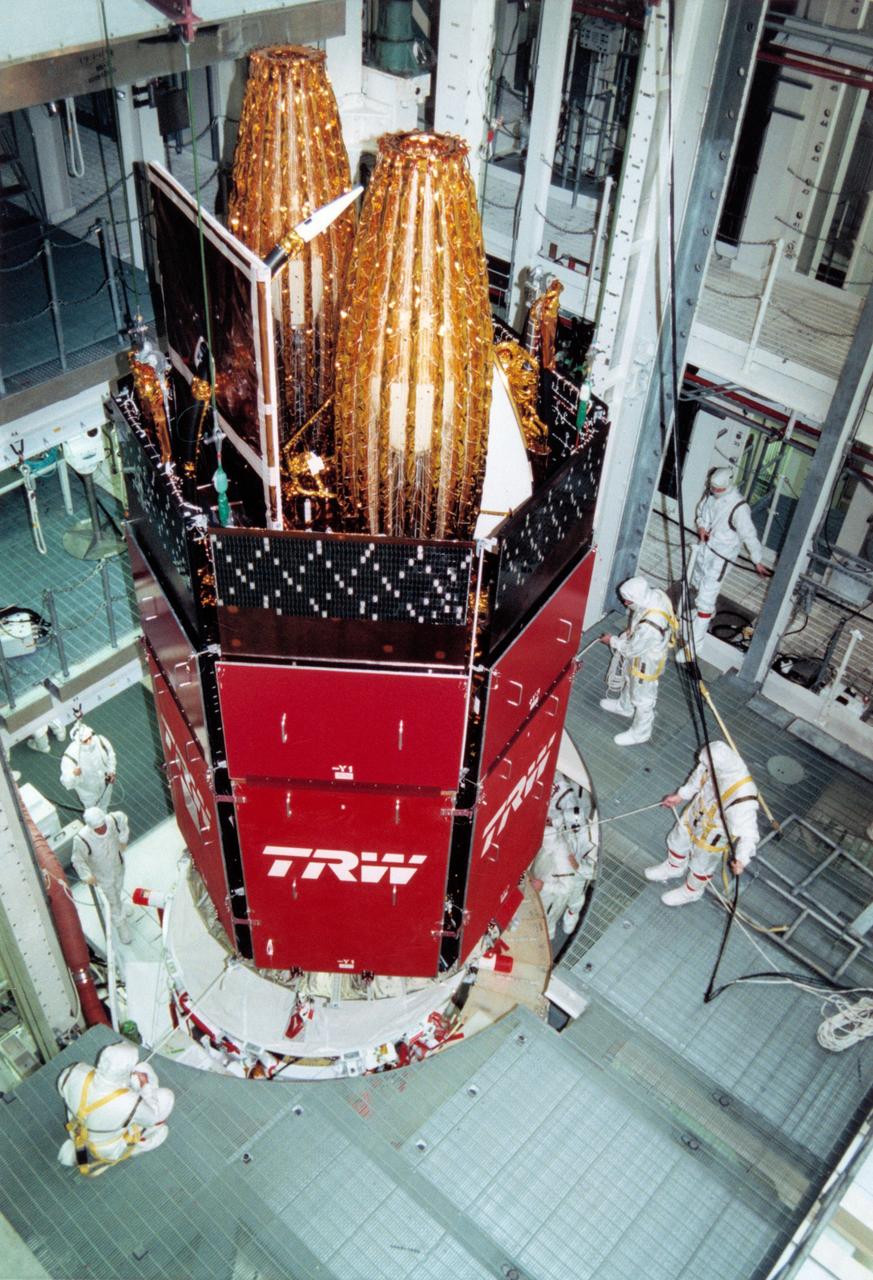
The Inertial Upper was a two-stage, solid-propellant transfer vehicle that carried heavy Shuttle payloads from toward geosynchronous, planetary, and high-energy science trajectories. It combined autonomous inertial guidance, three-axis stabilization, redundant avionics, reaction control, and gimbaled solid motors. A dedicated airborne-support cradle raised the stage and payload out of the bay for deployment. IUS configurations launched spacecraft ranging from Tracking and Data Relay Satellites to Galileo, Magellan, and Chandra.
Parent systems
The larger spacecraft or system this hardware belongs to.
Vehicle component dossier
Identity and integration
- Stage configuration and designation
- Inertial Upper configured as a two-stage, solid-propellant upper stage
- Shuttle integration and deployment interface
- Airborne Support Equipment restrained the stack, raised it above the payload bay, and released it for free flight
Propulsion performance
- First-stage average thrust
- Approximately 44,000 pounds-force in the standard configuration
- Chandra first-stage burn
- About 46,198 pounds-force average thrust for 125 seconds
- Chandra second-stage burn
- About 16,350 pounds-force average thrust for 117 seconds
- Motor thrust-vector control
- Gimbaled nozzles and actuators controlled pitch and yaw during powered flight
Propellants and feed systems
- First-stage propellant load
- Up to approximately 21,580 pounds in the standard configuration
- Second-stage propellant load
- Approximately 6,000 pounds
Dimensions and construction
- Overall length
- Approximately 17 feet
- Maximum diameter
- Approximately 9.25 feet
- Typical loaded mass
- Approximately 32,500 pounds in the Chandra mission configuration
- Stage construction
- Aluminum skin-stringer shells with longerons and ring frames
Operations and evolution
- Transfer operation and performance
- Baseline design could deliver about 2,268 kilograms from Shuttle orbit to geosynchronous orbit
Additional specifications
- Guidance and control
- Autonomous inertial guidance with three-axis stabilization
- Avionics complement
- Guidance, navigation, control, telemetry, command, data management, reaction control, and electrical-power equipment
- Redundancy architecture
- Vital avionics, thrust actuators, reaction control, ignition, and separation functions were redundant
Supported mission records
Missions that carried, used, tested, serviced, or depended on this hardware.
Photo Archive
Documented views of this individual vehicle, with source and credit retained alongside each image.